Showing posts with label France. Show all posts

Thursday, July 13, 2017

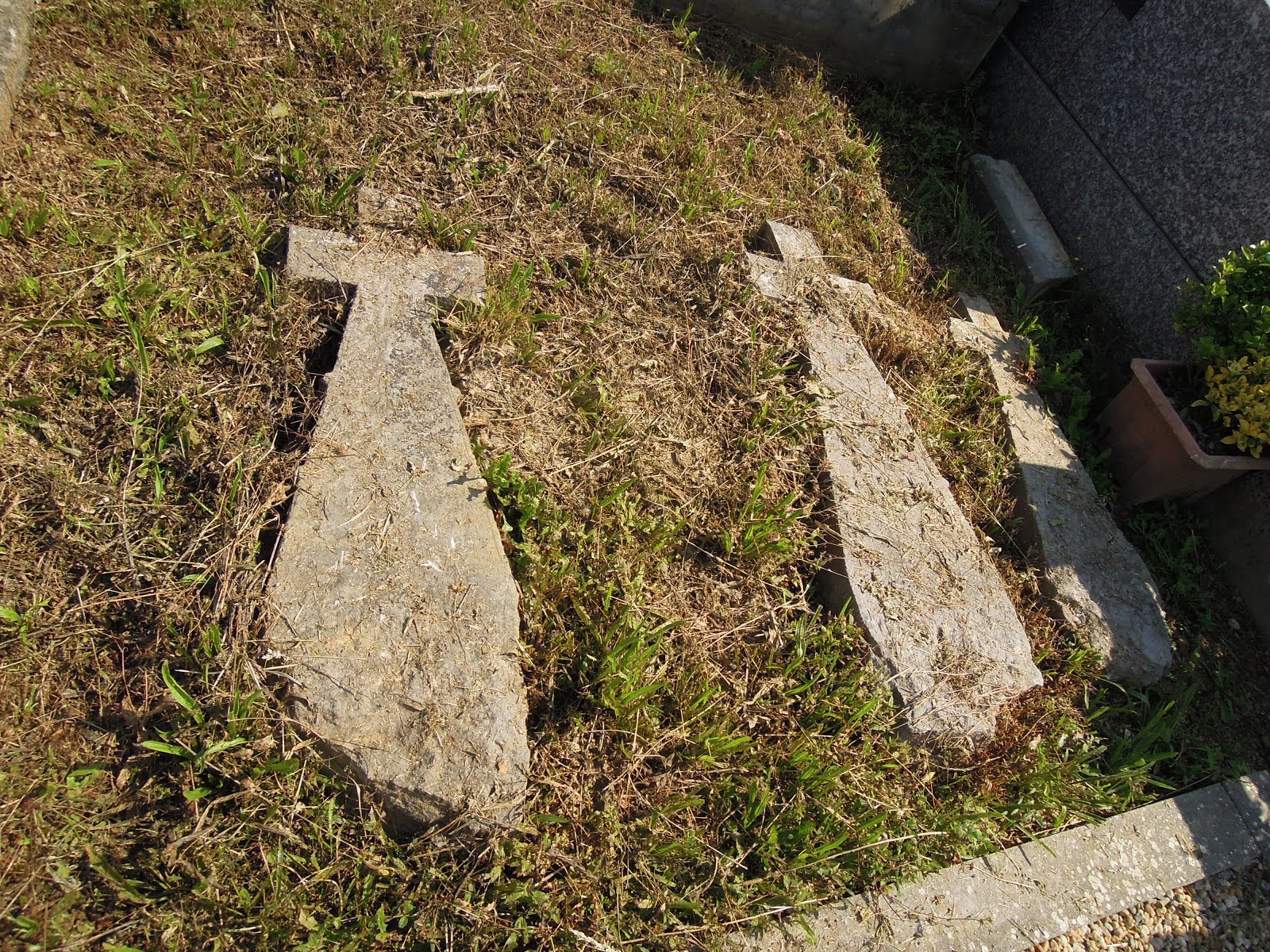
Forgotten gravestones in the Basque Country


I had the opportunity to visit Barcus and Esquiule last​ year, their churches, graveyards and town halls. But only Marie Larrory was supposed to be buried there (Marianne Etchegoren migrated with her family shortly after Marguerite Lerdou was born). Unfortunately she was not in the grave of the present-day Larrory and she could be buried in one of the many unkept headstones which names are almost completely erased. 

We waited for the town hall to open and asked for information regarding these tombs. They had none, the oldest records went missing a long time ago and recommended to try to identify them by gravestone rubbing. They were many headstones in this pitiful condition and we were only there for the day. I guess a collaborative restoration and indexing project is in order.


Carved in stone? Cemeteries and headstones as a Genealogical resource.

When you start playing rock-paper-scissors, you may intuitively consider the paper as the weakest element and the rock as the strongest. But the beauty of the game is showing that all three elements are just as resistant. It just depends on how we use them.
Unless you are very very lucky, you've been there, you've seen the paper trail vanish in front of your eyes: lost baptismal books, torn marriage records, missing pages of a notary's archives, whole churches burned to the ground (yeah, thank you, Carlist Wars) or plain and simple bureaucratic stupidity.
But of course, silly me! It is just paper! So you consider using a tougher material. After all, that is the whole purpose of a headstone: eternity.
Some headstones display a lot of information, besides the usual dates of birth and death, and the FAN (Friends And Neighbors) strategy can uncover even more data. Moreover, if you are well versed in the subject of funerary art, you could even come up with an accurate profile of the family's socioeconomic status. So, again, the strength of this resource depends on how we use it, but also, the cultural context of our ancestors, and our own.
I've had avoided cemeteries as much as possible. In my culture (catholic-based but no more, extremely urban and obsessed with youth), you can easily ignore they even exist. But then I visited France and found myself walking around the well kept graves by the church of a village in Alsace. They didn't have tons of information but many had those telling details of lives well lived and suddenly, I didn't find it so gloomy. Then, it became easier, and, given the chance, I would visit the cemetery whenever I visit a village.
But when it comes to bigger towns, it is a whole other story. If they are not glamorous historical places where you can find A-list celebrities like Oscar Wilde in Pére Lachaise, Jean Paul Sartre and Simone de Beauvoir together in Montparnasse or Evita Peron in Recoleta, they can be quite sad.
Left: Oscar Wilde in Pere Lachaise, Paris. Center: Jean Paul Sartre & Simone de Beauvoir in Montparnasse, Paris.
Right: Eva Duarte de Perón in Recoleta, Buenos Aires.

But again, what are the chances of finding your great grand uncle buried next to Jim Morrison? (Hopefully, very low, the place is a mess).


Their big advantage is that they usually have an administrator, databases, a direct phone number and an e-mail address (seems obvious? Well, some of them don't). So when I started to work in Genealogy and ran out of resources to find information about that narrow time-frame between my elder's memories and public available data, I had to chose rock. Luckily, at least two of the main branches of my tree had established in the same town back in the Province of Buenos Aires, Argentina (and their cemetery has an institutional e-mail address!).
I wrote my first email asking about my Sosas 8 and 9 with estimated dates and got an immediate reply from the administrator. 8 was there, and I got an exact date of death, but 9 wasn't (she was quite a character, actually). I've continued to email for information about other ancestors so I could ask the civil registry for death certificates, which were free of charge if you can provide the exact date (if you can't, you can pay, they will take your money and still not search for the records). I was filling the information gap faster than ever (except for my dear Margherite, who's date of death was missing).
Later the same year, I had the opportunity to go home and took my parents to a Genealogy road trip to our ancestor's town. Long story short: the copy machine of the civil registry was broken (so, logically, no searches), there was nobody in charge of the records in the church and the café across the main square was closed for mourning. Everything seemed to point out in the same direction. So we finally visited the cemetery. My contact was on vacation but I got a glimpse of how they had their files organized: a big poster with the coordinates of the parcels and an excel sheet that can only be opened in a very old PC that runs on Windows 3.11. Of course they have the original books but when we don't know the dates, it will take them too long to find what we need.
Big deal! All the information is carved in stone, right? Well, maybe initially it is, but sometimes headstones or metal plaques are removed, changed and summarized, losing all those telling details a database can never reflect.

To be continued... in France and Italy...

Monday, July 10, 2017

The Etxe strategy


Recap: After one unsuccessful attempt, one not even tried, and one shortcut, I found a way to leave the comfort zone and try a new technique to search for Marianne's hometown. Voici, la Etxe!

Esquiule is part of the Basque Country and for the Basque culture, the father's house (maison in French, Etxe in Basque) remains in the family for many generations, if not forever. This way, the houses become lieu-dit or landmarks and sometimes the street also carries the family name. There could easily be a Maison Etchegoren nearby.
So where in the area may the Etchegoren house be? According to Google maps, there is a maison Etchegoren and belongs to Barcus, the closest town to the West. This house is also mapped in the cadastre (a map that registers the properties of a certain district). 

Right: Cadastre of one of the districts of Barcus. Left: detail with the maison Etchegoren and neighbours.

I browsed the Tables Decenales of Barcus around 1818 for the birth of Marianne (who was 34 years old at the time Marguerite was born) and the next decade for her wedding. I found a Marie Etchegoren in 1815 (math was not their forte, or they really liked to lie about their age) and the wedding in 1843 of Gabriel Lerdou Hilarreguiborde with a 27-year-old Marie Etchegoren (born about 1816). Was she the same person?
Fortunately, the mayor of Barcus in charge of writing down the act clears this out for us: "Marie surnomée (a.k.a) Marianne Etchegoren". Both acts also name Marianne's parents: Benoit Etchegoren and Marie Larrory.
The marriage record has an extra hint. Before the name of her mother, there is the particle "feue" which means the late (as in deceased). Marie Larrory had died before her daughter's wedding and I found her death record in 1838, she was 51 years old but the only information of filiation is regarding her husband and his house.
This was a new opportunity to test the Etxe theory: Google it, or even better, Cadastre it. The house of Larrory is literally down the road (take another look to the detail in the picture).

Unfortunally, the Tables Decenales don't go back in time forever and neither does the civil registry.
But, it is still to be continued...

La theorie de l'escargot...


Recap: I had traced Margherite Lerdou all the way back to Esquiule, France, where she was born and cofirmed the names of her parents: Gabriel Lerdou Hilarreguiborde, born in Esquiule, and Marianne Etchegoren, born elswhere. Seems like I will be heading... Elswhere.

Leaving your comfort zone is not easy, but since you are already there, you might as well get something done. So I tried my old trick of Geopatronyme for the Etchegoren lastname but with only 5 hits between 1891-1915, the distribution was not going to mean much.
There was an even older trick, that I hadn't used before, and that some experts like to call “L'escargot”. No, it doesn't mean it will take forever to search for records in other towns, quite the contrary. We grab a map of the area and we pin the last known residence of the person (in this case was Esquiule, where Marianne gave birth to Margherite), that will be the center of our cloud of possible hometowns. Then, it is pretty much like connecting the dots, we draw a line to the closest town and the next dot should be as close to the center as possible (you will probably end drawing a snail, which I hate so I don't care about representing them correctly).


It does seem logical and sometimes it works. But we must keep in mind the circumstances in terms of Geography and History. What if there are mountains (like in this particular area) and towns are better connected by the roads of the valley than across the mountains? What if there was an exodus towards the cities?! Which cities?!! Where they moving east to reach the Mediterranean, or west, towards the harbours of the Atlantic to migrate to the Americas???
Don't panic, there is still one more trick that I learnt later and should work very well for those researching their Basque roots.


Tuesday, October 11, 2016

Un ticket pour Pau, s'il vous plait.

Previously...
Marguerite Lerdou was born around 1853 when the civil registration of France was well established. The Departamental Archives of the Pyrenées Atlantiques based in  Pau are available on-line for free but not yet indexed. Another advantage of the French registries are the Tables Decenales: an alphabetical index of all the births, marriages and deaths spanning 10 years. They are real time savers.

I started with Esquiule, the highest ranking village and found Marguerite in 1852 with matching age and parents. Except that Marguerite's father was not named Cayetano (which wasn't surprising since it was a very strange for France) but Gabriel Lerdou Hilarreguiborde and Mariana's correct spelling was Marianne Etchegoren (I learned later that in Basque could sound the same). I wanted to dig deeper but I hit another wall with the lack of information about Marianne's origin: her marriage and birth act are not registered in Esquiule.
But she couldn't be too far.

To be continued...

Sunday, October 9, 2016

Marguerite, vous êtes à peu près par ici.

Previously...

Recap: The earliest information we have about the Chanquet-Lerdou family is that their daughter was born in 1880 in Marcos Paz, Argentina but that both parents have always declared to be French.

Back in the day there was no civil registration in Argentina so most people didn't need to prove their identity or origin if they were white enough, seriously, it is written in some acts. A simple declaration was enough and sometimes the priest would assume the origin depending on the family name or the accent but sometimes, people would simply just lie.
If Marguerite was really French we should be able to find her birth records in France. But where? Were there any other available records that would lead us to her hometown? Sometimes wedding records carry more information. However, although her daughter was born in Marcos Paz, the wedding records do not appear in the same church. It could had been back in France but I took a shot searching in Argentina.

Fortunately, many of the records from the province and the capital are indexed and a quick search in FamilySearch can help a lot, if we know how to properly filter. I was lucky, they married in one of the churches of the capital the year before Graciana was born. The act shows the names of their parents: Pedro Chanquet & Gracia Pelot for Juan; Cayetano Lerdou & Mariana Echegoen for Marguerite Lerdou. Strangely, Cayetano Lerdou and Gracia Pelot are declared as Italians although they carry French names. Marguerite is again declared as French but without specifications.


Despite the scarcity of information in early church records from Argentina, there are other ways to solve this problem and like with many other things in life, I start with a Google search. As powerful as this search engine might be, it is still very useful to keep our brains plugged in and our filters clean so the more specific, the better.
For instance, if I want to narrow my search I should know how popular this name is. Geneanet and Genealogie.com both agreed: Lerdou is not a common last name in France nor elsewhere (peu populaire).

Screen cap from http://www.geneanet.org/
 
Screen cap from http://www.genealogie.com/
Geopatronyme allows to narrow the search geographically by region and town. Lerdou is highly endemic of the department 64: Pyrenées Atlantiques. And the highest ranking village is Esquiule.

Collage of screen caps from http://www.geopatronyme.com/


The Archives of this department are in Pau and we can find them online.
Un ticket pour Pau, s'il vous plait!


To be continued...

Graciana, vous êtes ici

Previously...

I started with the oldest reliable information I had from about 100 years ago: according to our family's oral tradition her daughter Eugenia Ortalli was born in Saladillo, an agricultural city in the province of Buenos Aires, Argentina, where she spent her whole life.
Eugenia Ortalli (1906-1993), Saladillo, Argentina.
The records of Nuestra Señora de la Asunción, the only catholic church of the city at the time are partially available on line for free in FamilySearch although not necessarily indexed (and even when indexed they have spelling mistakes that don't resemble at all to the original). However, in some churches, the priest would add an index, that looks a lot like a black-book, and where we can search baptism acts by the father's name.


According to Eugenia's baptism act in 1906, her mother Graciana Chanquet, 26 years old was born in Marcos Paz, also in the province of Buenos Aires, but closer to the Capital.
The church San Marcos Evangelista was not yet build so she was baptised at Nuestra Señora de la Merced that belongs to Merlo and had also a handwriten index. I browsed for her father's name and found a match for the estimated birthdate in 1880. According to this act, Graciana's mother was 26 year old Marguerite Lerdou and Juan Chanquet, both from France.


However, there was a homonym ten years younger so it was wise to confirm the identity of her parents with another source, ideally her wedding with Eugenia's father, Juan Ortalli.

Traditionally, the wedding took place in the church of district where the bride lived but back in the day, people moved a lot as new colonies were established in the Pampas. Unsurprisingly, Graciana didn't marry in Marcos Paz or Merlo. Her family had already moved away so I took a shot to the second most likely place: where her children were born. Back in the index of Saladillo, listed under her husband's name there was her wedding record in 1902. This document confirmed the names of her parents Marguerite Lerdou and Juan Chanquet from France.

Just out of curiosity and because the source is also available, I looked for the Chanquet family in the second National Census of 1895. What I love about a census is that it is like a massive poster of family portraits all stitched togheter. Sometimes we are lucky but sometimes the records are only partially indexed so I dedicated an entire Sunday to browse the differents districts of Saladillo with my good eye while I watched a Kitchen Nightmare's marathon with the bad one. And there, in the middle of a bucket of spoiled chicken and coleslaw, I found the page where an Argentinean teenager named Graciana Chanquet (14) lived whith Margarita L. de Chanquet (13) and Juan Chanquet (12) from France.
It is widely known that you cannot just get a ticket to France, if I wanted to continue through my journey I needed a more specific destination.
To be continued...

The first postcard of my journey

Four generations of my maternal line.

This is one of my favorite pictures in the world. It was taken in the early 50's and shows four generations of women. The cute baby on the left is my mother. The woman holding her was my grandmother. The woman on her right was my great-grandmother and the women in the far right was my great-great-grandmother. They were all born in Argentina and so was I.
They carried different last names because, unlike in many other countries in Latin America, it is not customary to inherit the mother's maiden name to form a double family name. But what I find both interesting and beautiful is that their family names were from different origins: Perez from Spain, Balbiani and Ortalli from Italy, and Chanquet from France.
They all spoke Spanish, and so do I. However, according to my family's oral tradition my great-great-grandmother Graciana Chanquet also spoke French and I can't help wondering what would this picture look like if my great-great-grandmother was the baby. Who were these other four women? What language did they speak? And why was Graciana born in Argentina?
This is how the journey through my Matrilineage starts and that is the first postcard I share from it.
To be continued...

Español